

In an earlier blog, we listed the five reasons why motors fail. Now that we understand how motors fail, let’s talk about how we can use this information to preserve the health of your motors and motor-driven equipment.
Motors Get Stressed, Too
In the 1990s, Austin Bonnett realized that — regardless which component fails first — a handful of mechanisms cause multiple motor components to fail.[1] Bonnett identified these mechanisms as thermal, electrical, mechanical, and environmental stresses. Electrical stress relates to incoming power quality and equipment grounding. Mechanical stress includes the motor’s application, load, duty-cycle and mounting — and particularly the vibration that the motor experiences and produces in this application. Ambient conditions and contamination fall under environmental stresses.
While each of these stresses cause multiple motor components to fail, not all stresses trigger all motor components to fail.[2] For example, thermal stress — i.e., heat — affects all five motor components; it causes bearing grease to lose lubricity, degrades winding epoxy, inhibits cooling, initiates rotor core delamination, and even deforms a motor’s shaft. Figure 1 maps which stresses cause each motor component to fail.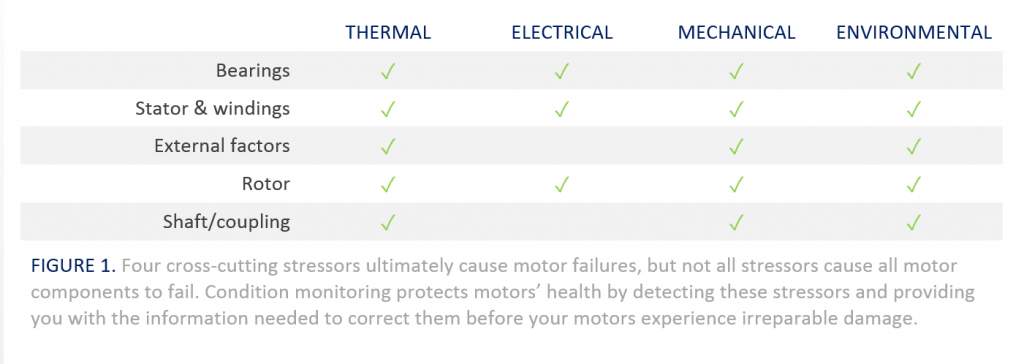
Your motor’s health is proportionate to the total level of stress it’s experiencing. Common motor health diagnostics measure the level of one stressor on your motors; for example, thermography measures thermal stress, while vibration detects mechanical stress. Much like your doctor tracks your temperature and blood pressure, monitoring your motor’s vital statistics — i.e., its normal operating parameters and stress levels — can indicate an issue long before it’s symptomatic of a problem.
How Condition Monitoring Works
 Condition monitoring works by collecting, sorting, and analyzing streaming data from sensors on your equipment [Figure 2]. Then, data analysis platforms, such as Motors@Work, apply complex algorithms to the incoming values to detect problematic conditions and update the virtual model — also known as a “digital twin”[3] — of how your equipment operates. The platform compares your equipment’s current performance to its manufacturer specifications and historical readings to identify performance “non-conformities,” or items that require action. Finally, the platform generates a report with asset history and sensor data and alerts you to these non-conformities, enabling you to determine the proper intervention — such as correcting a potentially motor-damaging stress before it creates a bigger issue or scheduling downtime to replace equipment.
Our next blog will detail the advantages of energy-based condition monitoring versus other condition monitoring techniques like vibration and thermography. To learn more about how condition monitoring can decrease your motor operations and maintenance (O&M) expenses by up to 25%,[4] download our white paper.
[1] A. Bonnett & C. Yung, 2004
[2] A. Bonnett & C. Yung, 2004
[3] R. Van Loon, “How IoT is Changing the World: Cases from Visa, Airbus, Bosch & SNCF,” LinkedIn (23 February 2017)