


Motors fail — it’s a fact of life that’s nearly as certain as death and taxes. But why do motors fail? The first step towards reliability-centered maintenance includes identifying and understanding the reasons why motors fail. Though age is commonly considered the primary reason for asset failure, Nowlan and Heap determined that only 11% of equipment failures are age-related.[1] The rest, they deemed, failed for “random” reasons unrelated to the age of the asset. While better manufacturing practices have reduced the number of “random” failures and increased the share of age-related failures since Nowlan & Heap’s research in the 1970s, age-related degradation still causes a minority (18%) of equipment failures.[2] Motor failures follow a similar distribution to other asset classes, with age-related degradation causing a relatively small number of failures (10%).[3], [4] Here are the top five reasons for motor failure as compiled by EASA and other motor experts:[5], [6]
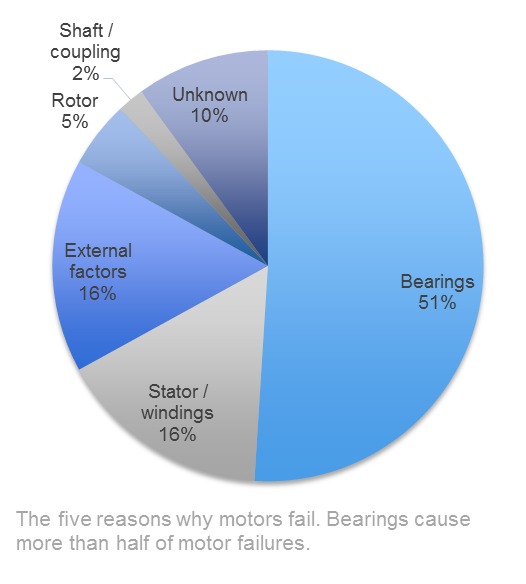
- Bearings: With 51% of motor failures attributed to bearing issues, bearing failure is the most common root cause for motor failure.[7], [8] Triggers for bearing failure include over- and under-lubrication; inappropriate mechanical loads (e.g., over-loading, radial misalignment, axial thrusting, belt tension issues); shaft currents; excess heat (leads to loss of lubrication); and contamination (e.g., using incompatible greases, water condensation, dust/dirt contamination)[9], [10], [11]
- Stator & windings: At 16%, winding issues represent the second most common root cause of motor failure.[12],[13] When windings fail, electricity arcs from one part of the motor to another, causing a short inside the motor. Potential causes of winding failure include over-voltage operation, excessive current, high ambient temperature or loss of cooling, an excessive number of motor starts or full reverses, physical damage and penetration of contaminants.[14]
- External factors: Causing 16% of motor failures, external factors cover environmental- and load-related failures, such as inappropriate mechanical loads (e.g., over-loading, radial misalignment, axial thrusting, belt tension issues); contamination (e.g., water, dust, dirt); ineffective maintenance practices (e.g., under-/over-lubrication); and Acts of God or War (e.g., flooding, excessive heat, bomb damage).[15], [16]
- Rotor: Rotor issues – such as broken rotor bars, broken end-rings, and core delamination[17] – cause approximately 5% of motor failures. [18], [19] Potential causes include excess vibration (e.g., radial misalignment, axial thrusting, highly variable duty-cycles); an excessive number of starts or reverses, or too-short of an interval between starts/reverses; long starting times; physical damage to the rotor; and excess heat (e.g., high ambient temperatures, over-load, or locked rotor operation)[20].
- Shaft/Coupling: In 2% of motor failures, the shaft or coupling fails. Causes of shaft failure include improper installation (e.g., radial misalignment, belt tension issues); excessive loading; corrosion; and physical damage to the shaft.
In the remaining 10% of motor failures surveyed, the root cause was either not investigated or was listed as undeterminable.
Now that we understand how motors fail, future blogs will discuss how we use this information to preserve the health of your motors and motor-driven equipment through condition monitoring. For more information on how you can use condition monitoring to decrease your motor operations and maintenance (O&M) expenses by up to 25%[21], download our white paper.
[3] http://ecmweb.com/content/explaining-motor-failure
[4] https://www.progress-energy.com/assets/www/docs/business/motor-protection-voltage-unbalance.pdf
[5] A. Bonnett & C. Yung, 2004
[6] O.V. Thorsen & M. Dalva, “A survey of faults on induction motors in the offshore oil industry, petrochemical industry, gas terminals, and oil refineries,” Proceedings of the IEEE Petroleum & Chemical Industry Conference (1994), Paper # PCIC-94-01.
[7] A. Bonnett & C. Yung, 2004
[8] O.V. Thorsen & M. Dalva, “A survey of faults on induction motors in the offshore oil industry, petrochemical industry, gas terminals, and oil refineries,” Proceedings of the IEEE Petroleum & Chemical Industry Conference (1994), Paper # PCIC-94-01.
[9] SKF, “The 5 most common causes of bearing failures in electric motors and what to do about them,” (February 2017).
[10] C. Radu, “The most common causes of bearing failure and the importance of bearing lubrication,” RKB Bearings (2010).
[11] Barden Precision Bearings, “Bearing Failure: Causes & Cures,” (undated).
[12] A. Bonnett & C. Yung, 2004
[13] O.V. Thorsen & M. Dalva, “A survey of faults on induction motors in the offshore oil industry, petrochemical industry, gas terminals, and oil refineries,” Proceedings of the IEEE Petroleum & Chemical Industry Conference (1994), Paper # PCIC-94-01
[14] A. Bonnett & G.C. Soukup, “Cause and analysis of stator and rotor failures in three-phase squirrel-cage induction motors,” IEEE Tranactions on Industrial Applications 28.4 (1992): 921-936.
[15] A. Bonnett & C. Yung, 2004
[16] O.V. Thorsen & M. Dalva, “A survey of faults on induction motors in the offshore oil industry, petrochemical industry, gas terminals, and oil refineries,” Proceedings of the IEEE Petroleum & Chemical Industry Conference (1994), Paper # PCIC-94-01.
[17] A. Bonnett & G.C. Soukup, “Analysis of rotor failures in squirrel-cage induction motors,” IEEE Transactions on Industrial Applications 24.6 (1988): 1124-1130
[18] A. Bonnett & C. Yung, 2004
[19] O.V. Thorsen & M. Dalva, 1994
[20] A. Bonnett & G.C. Soukup, 1988
[21] T.A. Cook, Maintenance Efficiency Report (August 2013)