


Today the monthly electric bill is one of your largest O&M expenses in the industrial and commercial sector, yet most companies do not manage their day-to-day operations to minimize electric expense. They process the utility expense (i.e. audit and pay the bill) but do little to manage the expense. Why? It is a complex problem that historically didn’t warrant the financial or environmental considerations it does currently. Times have changed.
The first step in managing energy expense is knowing the where, when and why of your electric expense; knowing where your energy dollars are being spent, knowing when your electric dollars are being spent, and knowing why your electric costs are what they are. To understand the answer to these questions is understanding the Utility Bill rate structure. What portion of the bill is for electrical consumption (kWh) versus peak power demand (kW), are rates seasonally differentiated or higher at different times during the day, or are there other variable charges that can be managed?
THE UTILITY BILL:
The Utility Bill serves two purposes
1st The Utility Bill indicates how much energy and power is has been consumed or used. The Utility Bill rate structure (e.g. Fig 1) is the guide for determining how costs are allocated and computed.
2nd The Utility Bill rates and expenses send accurate marginal-cost price signals to customers. The Utility by charging more during the peak period, when incremental costs are highest, as compared to times of lowest use are deemed “off-peak” provides a basis for financially engineering utility rates into a customer’s consumption and use. These rate signals are used to promote Customer operating modification, whereby helping the Utility normalize their demand and avoid the need for additional generating capacity. Energy charges between peak and off-peak times might vary by more than $0.10/kWh or 500%.
Similarly, demand charges may be computed at a much higher rate if the highest-demand interval occurs during the peak hours.
Energy and demand costs are controllable, and the benefits of implementing energy conservation, demand management, or power factor correction are directly related to the way a facility operates and the structure of the rate schedule. Inherent to this is to avoid basing energy management processes and controls on “average” energy costs. Managing the energy expense should focus on the incurred variable expense components of the Utility Bill. The following are the most common variable charges for a commercial or industrial billing statement:
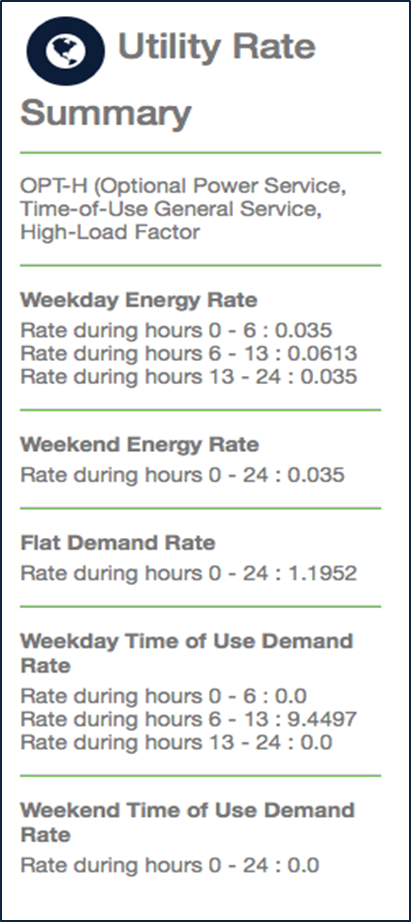
Consumption: The actual electricity consumption is calculated by multiplying the total kWh consumption by the applicable rate schedule kWh Rate.
Demand: This is the actual kW demand and is calculated by multiplying the kW reading by the applicable rate schedule kW Demand Rate. The demand kW shown is the highest kW recorded in any 15 or 30-minute duration over the monthly billing period.
Power factor (PF): The PF percentage shown on the bill is determined from the kVARh consumption coupled with the real (working) power and apparent (total) power. The actual charge for PF below 95% is calculated by multiplying the kVARh consumption by the kVARh Rate.
“A NEW OPERATING PHILOSOPHY”: OPERATIONAL RATE INTEGRATION
While power factor correction is not generally undertaken for energy conservation initiatives, it can result in a reduction in electrical resistance and can be very cost-effective counter-measure that could result in significant reductions in a utility bill. However, for the purposes of this discussion, we will focus on consumption and demand costs. Also, it is assumed that motor and driven-system efficiency opportunities have been addressed.
To solve the operating and rate structure challenges there are several major hurdles needing to being addressed. First is management’s commitment to changing their existing operating philosophies. This is easier said than done and typically requires a well articulated business case. Second is the intelligence to determine the optimum motor and driven-system operating configuration at the right time to minimize the electric utility expense while meeting the company’s valid operating requirements. This is a very complex problem to solve. Taking into consideration motors and driven-system’s varying efficiencies, interdependencies, availability, capacities, demand requirements, coupled with complex Utility energy and demand rate schedules makes the challenge of optimizing the energy costs difficult at best, if not impossible. It requires a systematic approach.
THE SOLUTION: ENERGY OPTIMIZATION THROUGH IoT INNOVATION
Motors@Work puts the power of the Internet of Things (IoT) into practice to solve these problems. Motors@Work energy optimization brings together all of the interdependent disparate data, certified analytics and patent-pending innovation to provide the operating intelligence needed to optimize the Customer’s motor and driven-system’s energy use and demand expense.
THE BENEFITS: 15 TO 30% OR MORE ENERGY COST REDUCTION
Peak time-of-use rates and demand charges can comprise 30% to 70% of a Company’s electric bill. Operating the most efficient motor and driven-system configuration at the right time and right configuration in order to satisfy demand is critical to optimizing the energy expense. Motors@Work provides the operating intelligence to do so saving the customer 15 to 30%, or more, on their energy spend. The savings potential is so significant it may justify investments in added equipment and infrastructure based on the reductions in energy and demand charges.
Additionally, in factoring in the Electric Utility’s marginal cost price signals into the optimization process will free up peak electric capacity demand and mitigate the potential need for the Electric Utility to have to build new or acquire additional capacity to meet their customers needs.
2 Comments
Comments are closed.