


Previous Motors@Work Blog posts have focused on many different aspects of motor life-cycle energy performance and the potential benefits from a design, operations and maintenance, and system level optimisation perspective. A critical topic, which has not been addressed, is the organisational accountability and responsibility alignment necessary to ensure success. Organisational Accountability is a management strategy ensuring “motors and driven-systems operate as expected at the least energy cost so that each motor or driven–system contributes to meeting the operations overall energy performance target.”
Motors and driven-system life-cycle energy performance management is a collaborative intra-discipline strategy. To be successful it requires defined discipline responsibility incorporated into the day-to-day life-cycle business processes. Fig.1 depicts the motor and driven-system life-cycle process functional discipline alignment.

The disciplines include Engineering, Operations, Maintenance, Finance, Energy Mgt., Procurement, and Inventory Mgt. requisite domain expertise.
Inherent in the life-cycle Motor Energy Performance management process is:
- Management commitment for placing emphasis on energy efficiency and motor energy expense as an important cost
- Organizational alignment where accountability and responsibility for motor operating performance, cost and efficiency are one and the same
- Integration into day-to- day business processes as opposed to looking to audits and projects to deliver sustainable benefits
- Sustaining the motor efficiency program inertia through communicating to the stakeholders of the benefits being derived
So here is a test. Fill out the following scorecard, rating each organizational discipline from 0 to 5, 5 being the highest level of energy performance responsibility and accountability compliance in your organization.
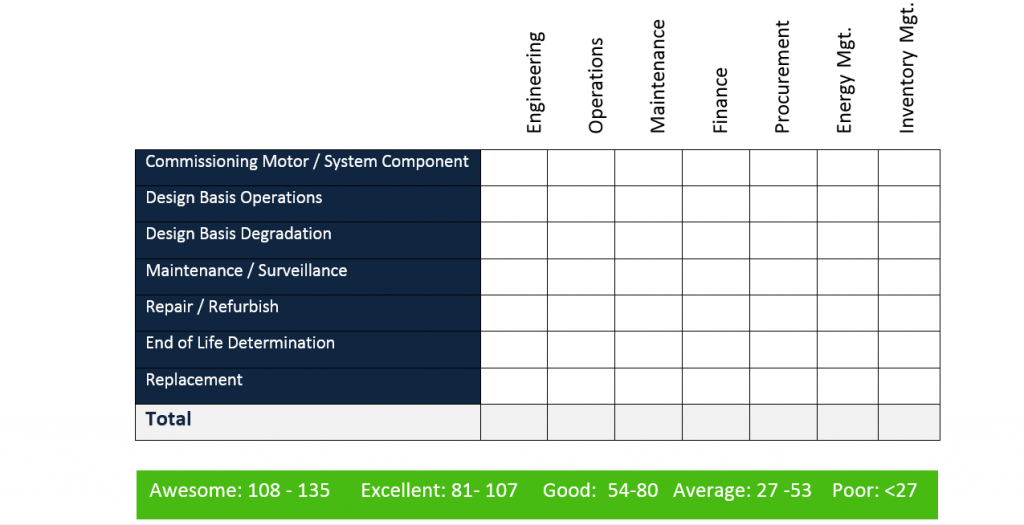
Total each column (by discipline). Then, add the column Totals to arrive at your score.
So how did you do? Awesome, Excellent, Good, Average, Poor? My point is that motor and driven-system energy performance management is a complex business problem to solve and spans an organisation’s functional silos. To solve this problem an organisation needs a collaborative analytics tool. Motors@Work understands the interdependent factors and provides the intelligence necessary to optimise the motor and driven-system life-cycle energy performance. Contact us today at info@motorsatwork.com for more information.