

Let’s face it — there is no way to justify replacing all of your failed motors. Repairing the motor will be the best option for at least a few of your motors. So what’s next?
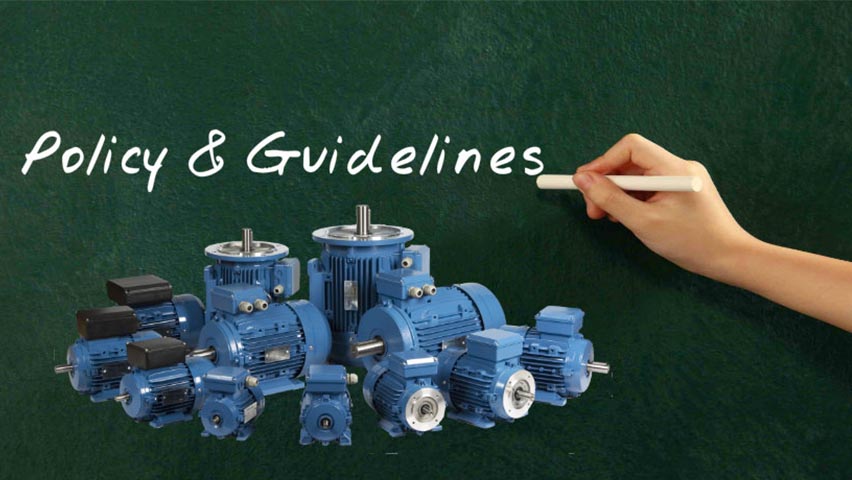
Studies show that motor efficiency drops 1% to 5% on the first repair, with further decline with repeated rewinds.[i], [ii], [iii], [iv], [v] Yet, studies conducted by EASA and Advanced Energy have proven that motor rewinding can in fact, improve motor efficiency by up to 1% when utilizing best practices.[vi], [vii] Motor repair guidelines helps you protect the performance of your repaired motors, ensuring they achieve the same speed, torque, and efficiency as they did when new.
At a minimum, your motor repair guidelines should address who performs your motor repairs and how they’re completed — i.e., whether you plan to perform the repair in-house or outsource, and whether you require certain documented repair procedures be followed.
Who repairs your motors?
If you outsource your motor repairs, your motor repair guidelines should identify your preferred vendor. But I also recommend using your motor repair guidelines to establish criteria for assessing whether a repair shop is well-equipped to perform best-practice-level motor repairs. These criteria give you a way to assess whether your currently preferred vendor provides the best-value service and ensures any future review of repair services procure high-quality services.
At a minimum, a service center should be able to provide a root-cause analysis on your motor failure, spell out your repair/replacement options, highlight their prior experience servicing similar motors, and outline their repair procedures and warranty details. For more on our recommended criteria, see our blog on the four must-ask questions for assessing your motor repair shop’s performance.
How are your motors repaired?
Whether you repair your motors in-house or outsource it, requiring ANSI / EASA AR100 best practices helps maintain — or even enhance — the energy efficiency and reliability of your repaired motors. The AR100 standard provides a comprehensive list of best practices covering mechanical repair, electrical repair, rewinding, and testing.
Best practices prescribed by AR100 include
- Providing a quality assurance program and warranty
- Replacing all broken and worn parts per OEM specifications
- Conducting stator core tests both before and after winding removal to check for stator core damage and
- Repairing or replacing defective stator core laminations
- Calibrating all test equipment and measuring devices at least once yearly to the national standard to ensure accuracy
- Recording winding resistance and room temperature before and after repair to ensure that the resistance measured is within spec and balanced on all three phases
- Carrying out insulation resistance test, surge comparison tests, high-potential tests, nominal and no-load testing
- Regulating power supply to ensure good power quality at the appropriate rated voltage for motor tests
Of course, your relationship with the service center is key to receiving the quality promised by the AR100 standard. Rushing the repair can result in sub-optimal motor efficiency and reliability. Plan well in advance for motor failures and keep critical spares in inventory to minimize downtime.
For more information on how our software can help monitor your motors — and proactively plan for future motor failures — contact us at info@motorsatwork.com.
[i] WU McGovern, “High efficiency motor for upgrading plant performance,” Electric Forum 10.2 (1984): pp. 14-18
[ii] RS Colby & DL Flora, Measured efficiency of high efficiency and standard induction motors, (North Carolina State University: 1990
[iii] DH Dederer, “Rewound motor efficiency,” Ontario Hydro Technology Profile (Ontario Hydro: 1991).
[iv] Zeller, “Rewound high-efficiency motor performance,” Guides to energy management (BC Hydro: 1992)
[v] Ontario Hydro, Rewound motor efficiency, TP-91-125 (1991)
[vi] Z Kellum, “The effect of rewinding on induction motor losses and efficiency,” Energy efficiency in motor-driven systems: Proceedings of the third EEMODS conference held in Treviso, Italy, 18-20 September 2002 (Springer: 2003): pp. 196-201.
[vii] Electrical Apparatus Service Association, Inc., & the (UK) Association of Electrical & Mechanical Trades, The effect of repair/rewinding on motor efficiency (2003).