


Previous Motors@Work Blogs have focused mainly on motor energy efficiency. Albeit there are numerous benefits to be gained from a motor efficiency program, a more holistic approach ultimately provides the greatest potential benefits.
System level efficiency improvement can range from 15% to over 60%, depending on either a core or total system approach. These efficiency gains can result in a significant reduction in energy costs. In water utilities, one such system efficiency approach gaining traction is known as “Wire-to-Water,” the efficiency of a pump and motor together. Also referred to as the “Overall Efficiency” of the core motor system.
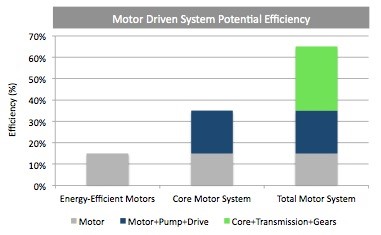
Today there are Government (NEMA and IEC) standards for the minimum efficiency of an electric motor, but they do not have any impact on the efficiency of a pump. For example a Subtype I, 100-horsepower, 1,800-rpm motor must meet a minimum efficiency of 95%, but no such restrictions exist for a 100-horsepower pump.
When asked how the total pump efficiency is determined, the most common answer I receive is that the total efficiency of a pump and motor is the average of the motor efficiency and pump efficiency. For example, if a motor is 90 % efficient and the pump is 70% efficient, the average would be 80%. This is an incorrect calculation. The total efficiency of a motor and pump when operating together is the product of their individual efficiencies. The total actual efficiency value ends up being significantly below the average efficiency. In the previous example, the total actual efficiency would be 63%, not 80%. This total actual efficiency, or wire-to-water efficiency, is a major factor when calculating the power cost for pumping a specific amount of water.
One of the more common management controls to manage the wire-to-water efficiency is the cost per thousand gallons pumped. The power cost per thousand gallons is directly proportional to the cost per kilowatt hour (kWh) and pump head while inversely proportional to pump and motor efficiency (eff) and is calculated using; Cost/1,000 gallons = (0.189 x Cost/kWh x Head) / (Pump eff x Motor eff x 60)
To better illustrate wire-to-water efficiency, let’s compare the electrical costs for two different pumps. The best efficiency point (BEP) for both pumps is 1,000 gallons per minute at 127 feet, and the electric cost is $.10 per kWh.
The first is a pump has a BEP efficiency of 85% driven by a motor with an efficiency of 93% resulting in a core system wire-to-water efficiency of 79%. At 60 hertz (Hz), the power cost at the BEP is $.05 cents per thousand gallons pumped. Note: the cost per thousand gallons is directly proportional to head, therefore the cost drops to $.042 cents at 55 Hz, $.035 cents at 50 Hz and $.028 cents at 45 Hz. If this pump runs eight hours per day at 60 Hz, the annual electrical cost will be $8,760.
The second pump has a BEP efficiency of 73% driven by a motor with an efficiency of 93% efficiency resulting in a core system wire-to-water efficiency is 68%. At 60 Hz, the cost at the BEP is $.059 cents per thousand gallon pumped.
Note: as with the previous example, reduced speed also results in a lower cost. Operation for eight hours per day at 60 Hz will result in an annual electrical cost of $10,337. In this comparison, an 11 % reduction in wire-to-water efficiency results in an 18% increase in power cost.
The U.S. Energy Information Agency reports that the 2016 average commercial cost per kWh across the U.S. were $.106 cents. This represents a 4.5% increase from July 2014.
Ultimately, as energy costs continue to rise, end users should ensure that their pumps operate at maximum efficiency and at the lowest energy cost to meet their demand. The benefits are too great to ignore. Contact us today at info@motorsatwork.com for more information on how we can help.