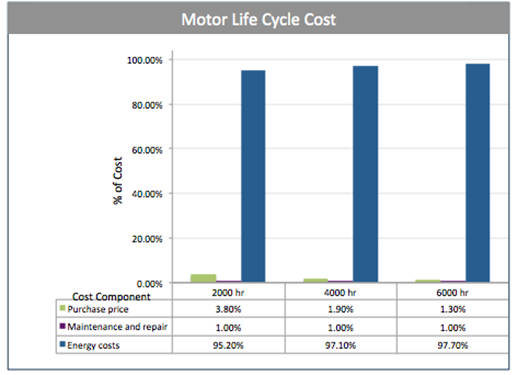
The objective of a comprehensive Motor Management Program (MMP) is to optimize life-cycle cost of a motor. MMP critical success factors include reliability, up-time, inventory, maintenance costs, and the motor’s energy efficiency. A proper MMP must be tailored to a particular location, and a successful MMP at one location may not be successful at another.
Motors fail for a number of reasons other than age or hours of operations. Making the right repair vs. replace decision when a motor fails is not always clear. When a motor does fail, in most cases maintenance and engineering must decide between rewinding, repairing, or replacing the motor, based on the best economic decision for a given motor. The decision analysis is typically, or should be, based on the following:
- Average cost of electricity
- Motor life expectancy
- Motor repair will result in “as-new” efficiency
- Motor repair cost as a % or new replacement
- Motor annual operating hours
- New vs. old efficiency differential
- Acquisition and installation and lead times are equivalent (if not then up-time must be considered)
Having this data will allow for a fairly straightforward financial analysis, comparing the difference in operating costs with the net increase in financial outlays (i.e. a new motor cost – rebuild cost), before-tax return on investment, after-tax return on investment, net present value cash flow, and internal rate of return. But making the right motor decision may not be as straightforward as you think. You also need to consider:
- Life expectancy of a rewound vs. new motor. New motors should be expected to have a longer life expectancy than a rebuilt motor. Rewound and repaired motor life expectancy benchmarks should be established and used for the analysis.
- Motor repairs should not be expected to bring a motor back to its original new efficiency. Studies have shown a degradation of 1% to over 10% is quite possible depending on the horsepower. Motor (in service) efficiency performance measurements and analysis should be conducted upon commissioning either a repaired or replaced motor to ensure the expected efficiency is being realized. In both cases, warranty claims for non-conformance may be an appropriate countermeasure for consideration.
- Replacement motor efficiency may not be the highest equivalent replacement efficiency commercially available. A rigorous supplier market analysis should be conducted to identify more efficient alternatives.
- Motor stator laminations condition may preclude the expected financial benefits to rewinding a motor rather than replacing it. A documented stator test should be conducted prior to rewinding. There should be minimal loss in efficiency if a rewind is done correctly – if no degradation has occurred in the stator laminations.
- If the motor repair can be limited to bearing replacement vs. rewind and bearing replacement. Obviously the cost of replacing bearings is much less than purchasing a new motor.
- If there are equivalent spares available in inventory. In this case the cost of the motor may be the depreciated value of the replacement motor in inventory and may well reduce the in-service lead time directly affecting the operating downtown. MRO motor inventory strategies should address up-time economics.
- Lastly, if a motor repair or replacement is coupled with a core motor system or total motor system engineering or maintenance initiative. Economies (engineering, maintenance, and operations) can be realized at the system level as opposed to a specific motor.
The bottom line is this: if energy costs represent over 90% of a motor’s life-cycle costs and if energy costs continue to rise at over 2.5% per year, then motor efficiency must be integral to the repair or replace financial analysis. The benefits are too great to ignore.